You are going to be in board meetings wherever you work. You will need to understand the relevance of business documents as well as take an active part in the chain of composing those business documents for business meetings.
Title Business Documents
Guidelines:
Candidates should compile a range of business documents including a business letter, memorandum, notice of meeting, agenda, minutes, CV and letter of application.
Evidence of drafting and redrafting should be attached to finished pieces.
At least one item should be handwritten.
Writing a Formal Business Letter
Uploaded by GCFLEarnFree.org
How to Write a Business Memo (memorandum )
How to Write Meeting Minutes
Useful CV and letter of application Video Tutorials
The CV videos are of Mairead Fleming, the Director of Brightwater Recruitment on TV3's Ireland AM.
How to Write a CV
Advice for running Effective Meetings
Effective Meetings in Plain English
Conflicts in Meetings
Occasionally, badly organised meetings can seem like some of the people involved really belong in a mental asylum as noone is often, noone is listening to each other. Meetings can often have heated exchanges. When in a meeting you need to consider: How do you think this meeting was handled? What repercussions do you think will happen as a result of this meeting? Was the conflict resolved? Where do you think the problem was?
Every Meeting Ever
Personal Writing
As well as a great plot, good creative writing involves planning, drafting and redrafting and editing
Think about the story to your favourite movie or book.
Do you think there was much planning involved or did the writers and scriptwriters just type away?
Do you think the actors would have had much say in the script?
Did the director interpret the script or film it word for word?
Do you think a writer consults anyone when crafting their ideas?
Why do you think book editors exist?
How to Write a Great Short Story - The 8-Point Story Arc
Drafting the Idea
The process of writing involves a lot of planning, drafts, editing and rewrites. You can see in this videoclip gow J.K. Rowling created the world of Harry Potter through drafts, rewrites, and drawings of the characters before the public got the book that reached millions.
Brainstorm and Mindmapping The Idea
Here is a video of mind mapping you might find useful for coming up with ideas for your story. Mind maps are a useful reminder and reference point to the writer. They are useful because you don't have to retain all that information in your brain when you decide to write your story. Include your mindmap with your assignment along with various drafts.
Youtube Video How To Mindmap
What is the story going to be about and what outcomes do you want?
Where will it be located?
Who are the characters?
When did it happen (presentm past or future)
How will you write the dialogue?
Why are you writing it?
Also consider:
The beginning, middle and end
What conflict and resolution will there be?
What style will you write in?
Editing
The last time you may have looked at grammar could have been in secondary school. As we grow older, it is easier to pick up bad writing habits, particuarly if we don't write that often.
Look for:
1-Spelling mistakes
2-Correct use of grammar like commas and inverted commas "..."
3-Structured paragraphs
What are the employment prospects of someone with bad writing skills?
Your writing is communicated to fellow employees, management or customers in your workplace, If there are alot of spelling mistakes or longwinded sentences that have no clarity, what does that say about you representing a company?
What does it say about the company?
As well as a great plot, good creative writing involves planning, drafting and redrafting and editing
Think about the story to your favourite movie or book.
Do you think there was much planning involved or did the writers and scriptwriters just type away?
Do you think the actors would have had much say in the script?
Did the director interpret the script or film it word for word?
Do you think a writer consults anyone when crafting their ideas?
An excellent documentary on how the recession in Ireland is having an impact on young people across the country by Stacey Dooley. This would be a great documentary to show in schools so young people could talk about and get interested in Ireland's future.
Ireland Lost and Leaving Part 1
Uploaded by ErmmNIPublished on Jul 4, 2012 Ireland Lost and Leaving Part 2
No matter who it is writing, we are all faced with a blank page.How do we get what is in our head on the page in a way that will communicate effectively to the reader?
As the Savage Eye show satirises, many writers get their ideas
by memory and observation as well as imagination
Putting Together A Piece Of Writing
Decide on the form of personal writing you will use.You have the option of one of the following:
(a) Story
(b) Review
(c) Letter
(d) Poem
(e) Letter
Consider how you will best convey:
(a) Your purpose
(b) Your topic
(c). The form which best suits it
(d). Your use of language
(e). Your personal style
(f). Your punctuation and grammar
Step 1 Brainstorm.
The only thing limiting you is your imagination. Getting all your ideas down on one page is useful. For example, draw a spider diagram and have fun.Think about plot, characters and setting.Or if you write 140 words starting with the given I dreamed that... in www.maxmydream.com then click lay, you will see a visual representation of your dream.Another possibilility is if you use www.toondoo.com you can create a comic strip to help you imagine your story.
Thish is where you finetune the 1st draft. You may wish to at this stage change some words which need to be changed. You may want to expand or reduce the piece.Editing your work can help refine your work into a more polished piece of writing.
Author of American Gods Meil Gaiman offers some advice to college students to use their creativity. Neil Gaiman - Inspirational Commencement Speech at the University of the Arts 2012
Perhaps you may not wish to write a short story but would rather express your opinion. Here is some help to assist you write a review
Writing a Review
Before we start, it is important to make this very clear. A review is NOT simply a retelling of a plot of a movie, it is an informed opinion or criticism. You are the person giving the reader an idea of why they should see or buy it.If you are going to approach doing a film review then please consider relevant information such as:
The director-is it a good or bad film?How?Why?How does it compare to their previous work?
Actors-did they play their parts well?
Characters-how believable were they?What kind of characters did they portray?
Plot-does the plot hold your attention or not?Why? Do not give away the ending!!!
Setting-where and when does the story take place?
Genre-what type of film is it? For this type of genre, how would you rate it and why?
Script-Could the script have been improved? is it well written? Were there any memorable quotes?
Please note that it is not simply a retelling of the plot
Here is an audio review of the movie Toy Story 3 by Mark Kermode
Or you may wish to apply the same criteria to reviewing a computer game?
Remember whether saying a film is good or bad, you need to back up your statements with reason and logic. Praise or criticise intelligently, do not simply criticise for argument's sake, look at the product objectively.
WARNING!Do not simply copy and paste what it says in Wikipedia. This is your own personal opinion, communicate some originality. Copy and pasting receives 0 marks.
Please take a moment to give me some feedback in the comments section
What was difficult in this task?
What did you learn?
Is there anything else that could have been included in the topic to make it easier for you to understand?
Was the topic explained well or not?
Are there any video links from Youtube that may also be useful? (if so please copy and paste the link in the comments section with a sentence explaining what it is)
You wish to attend Tommy Tiernan in concert in November 2011. Using the information in the advertisement and the recorded message from the box office, leave your booking requirements on the answering machine. Use a cassette tape for your recorded booking.
Guidelines Read the advertisement and extract the important pieces of information Summarize your requirements Evidence should include original information and taped message.
Assessment Criteria Extract and differentiates between essential and non-essential information. Message includes essential information with details, personal identification, date, time, contact number. Voice is audible, diction is clear, well measured pace Use technology/telephone confidently/expertly.
As more and more industries deal directly with a customer on the phone, it is an essential skill to be able to be able to receive and transmit information effectively.This assignment can show a possible future employer proof that this person is competent on the phone.
But I already know how to use a phone?Why do I need to bother with this?
At an interview stage, an employer can assess how competent you would be on the phone for their company, can they receive, record and transfer information effectively to achieve maximum satisfaction for the customer and business.
Have you ever been taking up for not listening by a parent, teacher, boss, partner or friend?We spend the majority of time listening to others, yet we may not have been formally thought the best way to listen.
Listening has 3 parts to it:
1.Hearing-being able to perceive sounds (eg a boring teacher where you know there are words coming out of their mouths but you haven't a clue what they are talking about.We've all been there!)
2.Understanding-the ability to make sense of those sounds (eg the teacher is talking about the assignment deadline date and what that particular assignment is about)
3.Retaining-having the ability to remember what has been heard (eg student goes home and remembers what assignment was discussed in class, what it involves and when it is due).
Listening involves your skills of perception.Do you listen better to information that interests you?Do you pick and choose what you listen to?Is it possible to prejudice or stereotype people unfairly as a result of your own selective listening? Source:
(eg don't listen to him,he never has a clue what he's talking about).
On the telephone, you can't see the other person. As a result, listening requires more concentration as you cannot rely on clues to find out more information like facial expressions,body language ornpossibly the physical evidence of their enquiry or complaint (eg computer problem).
Listening is an active process where you must get meaning from what is being said before you can respond.For example, if being given directions over the phone,you may need to go back over and summarise those points with the person who has said them in order for you to understand the information so you can retain it better.
Person A: Take the 2nd left after the lights, where you will pass some apartments on the right.Take The next turn right and after the 2nd roundabout we are located in the grey building on the corner beside the supermarket.
Person B: So 2nd left after the lights, next turn right, go through 2 roundabouts and it's the grey building on the corner.Is that correct?
Person A: Thats it
Informational Listening-listening for facts, names, times, dates, places.Repeating information until the message is clear can make the receipt and transfer of information flow smoothly.
Critical listening-making judgements or opinions based on the speakers message.For example in this assignment, your teacher should be listening
critically to how well you have prepared, structured, understood and
retained the information given and how well you have expressed your response.
Relational Listening-this involves empathising or sympathising with a friend or partners problems and concerns.With this type of listening, you may be interpreting hidden signs to understand another's feelings.There may be more to the message than the words you are hearing.For example,she says she is fine but really there is something else the matter.
Listening for pleasure-listening to your favourite music,watching a movie or stand up comedy.As you are listening passively, little concentration is needed.If you went to see a comedy show like Billy Connolly, how many jokes would you be able to remember afterwards?Or how many details of a film you just watched?If you are a musician you may listen to music with more concentration as you may be focused on how a song is constructed as opposed to the pure enjoyment of the song.
Listening to discriminate-where you are listening to eliminate the differences in sounds eg how parents can make decisions based on a baby's crying.Is the child crying because they need a nappy change,hunger or are they in discomfort.When dealing with annoyed customers,are they angry because they have been shortchanged, inconvenienced for being put on hold or dealing with electronic answering machines, or simply want to be listened to?
A lot of videos on Youtube in the comments section are often very clear examples of not listening.A lot of the time 2 opposing arguments can be responded to with insults as neither party wishes to concede another person's argument.
Imagine a typical class morning.What is preventing you from learning?
Are you disinterested in the speaker?
Can you understand what they are talking about?
Did you have a late night and are feeling the worse for wear?
Are you hungry or have something else on your mind?
Are you prejudice about the speaker's appearance, accent,views or use of language? Source:
Are you prejudice about the subject? eg Maths is boring, I want to make computer games,why should I listen to this? (some of you may be surprised by the answer by the way!)
Are you distracted by noise? Eg drilling outside, other classmates talking to you, noise outside the class
Are you unable to understand what the speaker is saying? Eg if it doesn't make sense do you switch off or engage the speaker to facillitate understanding?
Is the speaker too fast or too slow? Are they boring you by moving too slow or do you have difficulty keeping up with fast speakers?
Is the message being given too complex or unclear? Eg Did the speaker not explain it well enough for everyone to understand or are they pitching their subject at only a few in the room
Is your attention span limited.In the 21st century,we are bombarded with information on any subject we desire through technology.The mobile technologies we use have multiple applications and it is easier than ever before to communicate instantly with friends.Are you a morning or nighttime person?
Do you have a tendency to daydream?
We can only concentrate comfortably for 20 mins on average, and there may be particular times during the day when it is easier to concentrate,so how can we listen effectively for an entire day?
How To Combat Listening Barriers?
Selective Listening
What we select to listen to and whom we listen to can affect drastically our attention levels.If you are listening to an important message that needs to be passed on,you need to select the important information and omit the rest.Note taking is often recommended. do you listen to for news,or on Facebook,or at work or at home?Do you respect one person's opinion over another?Why?If you do then ask yourself do you spend more attention communicating with them?Do you focus your listening more on things that will benefit you? Source:
Active Listening
Show the speaker you are listening,especially verbally over the phone.The speaker does not know what is going through your head until you encourage them to say more.A simple 'yes' or 'ok' is encouraging the speaker to give more information.You are giving feedback and playing a more active role with how you listen.By taking part in the message, communication will flow smoother.
Eliminating Interruptions
Let the speaker finish what they have to say before contributing your point of view
Interruptions can display a lack of interest in what the other person is saying.It is communicating to the speaker that your point of view is more important than their points.This has the danger of leading to a negative experience.In instances like political debates it is often the case that each candidate has to fight to be allowed to finish their point
Responsive Listening
Demonstrate to the speaker not only have they been listened to but also that they have been understood.The speaker should feel with this type of listening that they have had their feelings and circumstances acknowledged,that their complaint has been listened to, that their feelings regarding the matter have been acknowledged and that the circumstances will be addressed.
Lets say in this example that the customer is disagreeing with what you are saying, you do not have to agree with them in every case.Responsive listening keeps the communication channels open between you and the customer.It is possible listening this way to disagree yet avoid conflict.
There are 3 techniques that can be used to do this
1. Summarising-by repeating back to the speaker what they have said or how you have interpreted the message
(a) "in other words..."
(b) "so what you are saying is..."
(c) "so your concern is that..."
2. Ask questions for clarification.If a speaker asks you something that you do not know the answer to, ask questions to the speaker until you are clearer
(a) "do you mean...?"
(b) "could you explain your problem in more detail?"
3. Using responsive phrases
"I can see your point..."
"I understand what you're saying"
"I can see where you're coming from"
With responsive listening, you want to keep the conversation going without taking it over.You must also come across sincere.How are you going to do that with your own unique style and tone over the phone?
Other Tips to Listen Effectively
Remove or ignore distractions
Concentrate on the content and not the delivery of the message.What is the meat of this message?What is the message essentially about.If the message is being delivered in anger try to focus on what is actually being said.
Focus on what you are getting out of this message-by focusing on areas of interest, it may help you to communicate better.
Give feedback to keep the communication flowing
Ask questions to demonstrate to the customer or speaker that you wish to help
Be objective-look at the situation from both sides before making a decision.Each message should be treated independently
Acknowledge the speakers emotions regarding the situation being discussed
Keep the conversation going so the speaker will feel listened to
Ask yourself questions internally to question the message
Observe the tone of the speaker for hidden messages
Note-taking
If you are in a doubleclass period in a particular subject in college, how much of that knowledge is retained a week or a month later?You may hear the information, you may understand the information yet when it comes to test time you may not retain it.Your memory will not withold all of the information unless you take notes.Writing it down can help your jog your memory when examtime comes along.As a teacher, occasionally I see some students take notes down only when their friend sitting beside them has.But if you don't put it into your own words you may have difficulty understanding the notes at a later date
The same can be said if you are taking a message in a large organisation, you will want details of the message and also check up on previous messages recorded with notes about that customer eg did they have a similar problem before?When did they last call?What was done about it? Etc
Tips For Taking Good Notes For College
Head the page with the date and subject-this allows for notes to be easily retrievable and help to minimise lost or mixed up notes of other subjects at the end of the year (which you will be thankful for doing)
Don't copy sentences word for word.Instead write notes in your own words so you understand them.
Summarise the main points to what is being said.You may wish to use abbreviations, use headings and subheadings, divide points into parts (a),(b) etc
Speaking
In the last part of Assignment 2 we looked at listening.This section involves how we can use speech and our voice to communicate our ideas, proposals and language to be a more effective communication persuasion tool.
It's not necessarily what you say but how you say it can drastically affect your messages impact.Ever try to repeat a comedian's joke but your retelling fell flat?
A powerful deep voice can sound more authoritative.Take for example James Earl Jones who played the voice of Darth Vader in Star Wars.Would his lines in the movie have been as authoritative if he had a high-pitched voice or a heavy Irish accent.
How you speak in an interview or in a business presentation can sometimes be more influential than what we may actually say.You can use language to alter the meaning of our messages.PR consultants for companies are often masters at this.
With carefully applied language, you can give your speaking a deeper resonance and depth, where your message comes alive through your choice of words
What To Be Aware Of When You Speak
Pitch and Tone
When nervous, often our pitch gets higher because our throat has been restricted.A monotonous tone can lead you to becoming easily bored to listen to.This is compared to inflection, where the pitch of the voice changes to emphasise our mood.There is a famous Father Ted scene below illustrating this point
Volume
You want to be heard when you speak. Loud voices often are most noticably heard however it should also be noted that a quiet firm voice can be a more effective methos
Emphasis
What words are you going to emphasise?Placing empasis on important words can highlight their importance to the listener. In order to emphasise, you must change your pitch and volume.
What words should be emphasised in these sentences?
1.The next bus to be departing will be the Dundalk to Belfast 100X on Platform 2
2.Don't ever do that to me again
3.Social Networking is the most popular use of the internet in the world today
4.Behaviour such as this will not be tolerated
Pace/speed
When we are excited, nervous or angry, we often speed up our speech.This has the risk of losing those trying to listen to us.Slowing down a bit can show that we are relaxed and comfortable speakers and allow our voices the room to give emphasis to particular words
Articulation
It is easy to be lazy with the speech we use, particuarly informally.Words and sentences can be contracted, twisted and shortened, mispronounciations can lead to misunderstandings
Speaking Formally and Informally
Speaking can be chaotic if not rehearsed.How would you feel if you were dealing with a customer service representative and their speech was filled with 'em','well', 'y'know like'.We often hesitate, give unnecessary information, stumble and restart our thoughts,particuarly in formal situations like presentations and job interviews.
Informal speaking is often relaxed and with people we know.The pressure may not be on as much if we make a mistake with friends or family compared to a business presentation.Informal speaking involves everyday conversation.
Formal speaking needs more structure and requires planning and rehearsal.If you give a debate, attend a work meeting, give a presentation,the pressure may be on to get your important point across.Maybe your audience knows nothing about the topic you are going to present?How will you structure it accordingly so it is easily understandable?
In 2010 Apple unleashed the iPad where we can see the person we are talking to.Numerous mobile phones now come loaded with videocalls.We can use Skype to see each other as we talk over the internet.How do you think that this is going to change the way we communicate by phone? What are the advantages and disadvantages that there are for being able to see the person at the other end.Your task is to research the following: iPad2, Google Android and video calls for your mobile phone companies and consider how this may affect how listening and speaking skills and requirements which were mentioned in the earlier posts for assignment 2.Post your comments here
Telephone Technique in the Workplace
Whether you become a receptionist,customer service representative or department manager good telephone technique can help get work done more efficiently.Poor telephone technique transfers into lost business.You are the 1st representative of that company that customer may be coming into contact with, so it is important to be able to impress them.
1. Speak clearly,it may be difficult for the customer to hear you, they may be out of coverage.Speak slower,be polite and try to neutralise your accent to be clear.
2. Be clear about what yiu want to say and how are you going ti say it?
3. Make notes of information transferred both ways
4. Keep record of your calls
5. Keep the communication channel open to further potential future business
6. Demonstrate patience and good manners to demonstrate professionalism for you and the company you represent
7. Be aware of your tone of voice
8. Apologise for delays (caller may have been on hold for a while in order to get through to you
9. Have sympathy with the caller
10.If message or issue has been resolved ask is there anything else they can be helped with and thank them for their call.
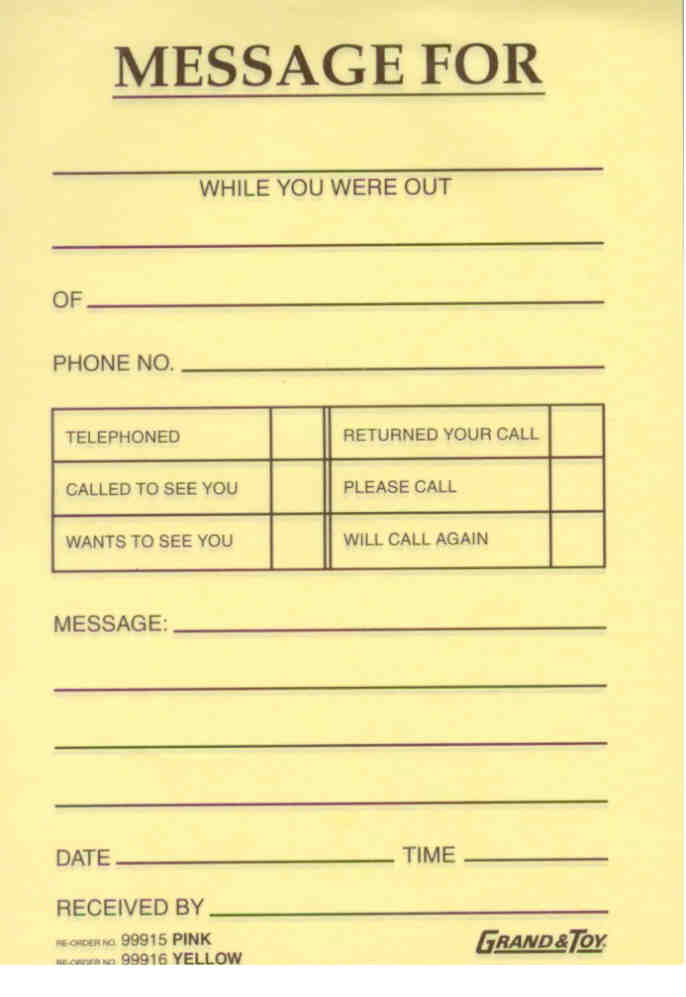
Phone Message Slips are often used in offices.Here is an example of one below: