“I have heard this term auditor before what does it mean and is it relative to accounting?”
An auditor is someone who checks the accounts of a company on a yearly basis. This is called an audit. It is there job to see if the accounts are a true and fair representation of the company’s affairs.
The auditor has to request access financial records such as assets, liabilities, bank balances, expenses and receipts of the business to perform the audit.
An auditor gives their opinion of whether or not the financial statements are an accurate and fair representation of the business.
An Auditor must be:
§Independent
§Fully qualified and registered
§A very good communicator
To learn more about the role of an auditor check out this humorous video link:
This is a term you will
see and hear in the business world. First there are shares. Shares are the
amount of interest a shareholder has in a company. These shares are viewed in
financial terms i.e. money.
§Shareholders
can come in the form of an individual, a group of individuals or a company.
§Shareholders
rights include the right to vote or nominated the directors of the company.
§The
right to sell their own shares or buy shares when they are issued by the firm.
§Shareholders
are also entitled to dividends if they are declared by the company.
To learn more about shareholders check out this website:
Share capital is the
money raised from borrowing, grants, selling of shares or funds from
shareholders or investors. There are two types of capital, issued and
authorised share capital. Issued share capital is the number of shares that the
company has issued. The amount raised is either lower or the equal amount of
the authorised share capital. Authorised share capital is the maximum amount of
capital that can be raised for the company.
For example Pacebook
decides it needs to raise capital for new investing activities. In their
company policy i.e. Memorandum of Association the maximum amount of authorised
share capital they can raise is €100 million. The company raised €50 million
from issuing new shares to the public and investors.
However raising capital
can be difficult for risky start up companies. For example a new start up
company called Apod ltd. sells only high quality socks. Apod decides to raise
capital by selling shares of the company to outside investors. These investors
are also called venture capitalists.
However you do not need
to be a new start up company to raise capital.
§Long
term financing can be achieved in the long term with share capital.
§Shareholders
are only liable for the amount of money they invested in share capital.
Check out these links to learn more about share capital:
Dividends are the
allocation of profits to shareholders of investments. They are declared i.e. proposed by the
company’s board of directors. It must be though approved by the shareholders first before any dividends are given out. One of the main reasons why people and firms buy
shares in a company is to earn profit.
§Dividends
are a part of the company’s profits which are generally given out to a company’s
shareholders.
§Dividends
come in the form of cash, property or stock.
§Dividends
do not happen all the time depending on the company’s policy and the
shareholders decision.
For example Ryanair are reluctant to pay out dividends
to its shareholders but have seldom done it in the past.
The best place to begin a journey into
accounting is at the start. Double entry bookkeeping was originally devised by
the Italians in the fifteenth century.
What are the principles used for in business?
The principles of double entry bookkeeping are
used for recording financial transactions that occur within a company.
Financial information accounts are recorded in the book called a nominal ledger
or another term is often used is the general ledger. An account is a page in
the ledger. These accounts in the ledger are usually called as T accounts. For example
a nominal ledger set up for assets where information about machinery or
furniture will be recorded. Other ledgers would be for rent, lighting and heat,
sales, purchases etc.
Here is an example of a T account that would be
recorded in a ledger.
What is meaning of the term “double entry” in
bookkeeping?
The words “double entry” explains that each
transaction that occurs within a business, that transaction must be recorded
twice. To do this with a ledger account we must split the page in two where on
the left it is called a Debit (DR) and on the right it is called a Credit (CR)
as above.
You might be asking yourself why do I need are
there two parts of the accounts? The answer to that is each transaction has two
parts. In other words each transaction has a debit and credit to it.
To find out more about debits and credits check
out this link:
Here is an example of the double entry book
keeping:
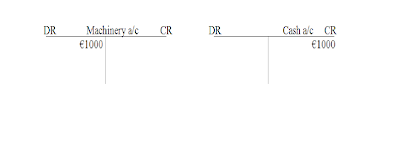
Trapattoni Ltd. buys a machine for €1000 cash. Here
we have two parts of a transaction. First the company has obtained a machine
worth €1000. Also the company has lost cash of €1000. The company records this
information in two accounts. The company records an increase in the machinery
account and it records a decrease in the cash account.
Which account do I debit and which do I credit?
The answer is we debit the receiving account
and credit the giving account. This is also referred to as the Golden Rule of Accounting.
The reason why this rule is so is because that’s what the Italians decided back
in the fifteenth century. They for all
could have swamped this rule around if they so wished.
The company receives a machine for €1000 so it
is recorded on the debit side and the company spent €1000 so it is recorded on
the credit side.
I can hear you asking “Wait, aren’t there
different types of transactions, how will I know where to put them in the
accountants?”
A wonderful question to ask! To answer it there
are four types of transactions: Assets, Liabilities, Expenses and Incomes.
You must remember your double entry. On the Debit
side there will be assets and expenses. This will always be the case.
On the Credit side it will be liabilities and
incomes. As same as above they will always be credits. The Liabilities and
Assets will only appear in the balance sheet and Incomes and Expenses will
appear in the income statement. The balance sheet and income statement will be
explained later on in your studies.
Hmm I think I get it, do you have an example I
can examine?
Of course, Keano Inc. has transactions that
have occurred within the month of June 2011. They need an accountant to record
these transactions within the accounts. They are as follows:
Shareholders invest €10,000 into the business
on June 2nd.
The company purchases €2000 worth of equipment
on June 5th.
Purchases were made costing €5000 on June 8th.
The company pays wages of €1000 on June 10th.
Rent of the building comes to €1000 on June 25th.
Keano sales for June were €5000.
Here we have a nominal ledger which contains
several accounts of a firm. As you can see some of the figures of the accounts
are on either the left or right side of the T account. As we mentioned before, there are four types
of transactions. Can you name them above?
We can also see the figures being double
entered. Where rent €1000 appears on the debit side of the rent account it
appears on the credit side in the cash at bank account. This goes back to what
was mentioned earlier, there is two sides to every transaction!
As seen in the cash at bank account the company
has a debit balance. This means that the company has brought in more money than
spent over June. If we had a credit balance it would be a Liability in which
the firm would have to get a loan.
Why should I learn
this double entry bookkeeping, can’t I get a computer to do this?
I hear you asking “Why can’t I do this on a
computer, would it be faster and easier” It is true a computer can do this but
a person has to know how to input the data into the system. This means they
must understand where each transaction or a group of transactions should go. If
a shareholder of a company asks you the Accountant, “Why did you put machinery
in to accounts of the books, should it not be in only one account?” It would
make you look very silly and your job in danger if you could not explain to the
shareholder the basic concept of double entry!
Why should I be an accountant?
There are
so many reasons to pursue a career in accountancy it can be best summed up with
these videos.
The books of prime entry record individual transactions that occur within the day to day running of a company.
These are as follows:
§Sales day book
This book records transactions that are associated with non cash sales i.e. credit sales that include information of customers, the amount, date of sale and description of the sale.
§Purchase day book
These book records transactions that are associated with non cash purchases i.e. credit purchases. The book includes information of the supplier, the amount, date of purchase and the description of the purchase.
§Sales returns day book
This book is used to record goods that are returned by the firm’s customers.
§Purchases returns day book
This book is used to record goods that are returned by the firm to the supplier.
§Bank Book
This book is used for recording bank transactions such as deposits and withdrawals. This can be also known as a pass book.
§Cash Receipts Book
This book is used for recording cash only transactions coming into the business.
§Cash Payments Book
This book is used for recording cash only transactions going out of the business.
So are you saying that we should disregard double entry altogether?
Most certainly not, never! If we used double entry to record every transaction that happened. A company would need an extremely large ledger which would be very difficult to manage every single transaction! These books sum up the totals for example 1 month. These figures are then put into the nominal ledger.
The Personal and Professional Development Class were asked to last week come up with a group activity. Both activities are taking place on Monday. You are asked to make a Powerpoint Presentation on:
The discussion to come up with your idea:
The planning involved in getting it set up:
The Challenges Encountered:
How it went:
In your teams you will also be asked to conduct a Powerpoint presentation in your group.
Please note : EACH STUDENT WILL BE INDIVIDUALLY MARKED
After some lengthy discussion with the Personal and Professional Development class, one of the challenges highlighted for them was the speed of their internet connection. The reason that this was mentioned as important was because many of these students like to Skype their families who are located in Malaysia.
As part of one of the exercises for this module, students have been asked to get together and to discover how to overcome this challenge with a variety of solutions. Roles will be assigned and decisions will be evaluated. Students must write about this in their journal with the following headings:
Pictured from left to right are Aaron Conroy, Stephen Farnan and Matthew Walsh of Dundalk Institute of Technology with their lecturer Derek O'Reilly, lecturer in DKIT and Dr Liam Noonan, lecturer in LIT Tipperary.